
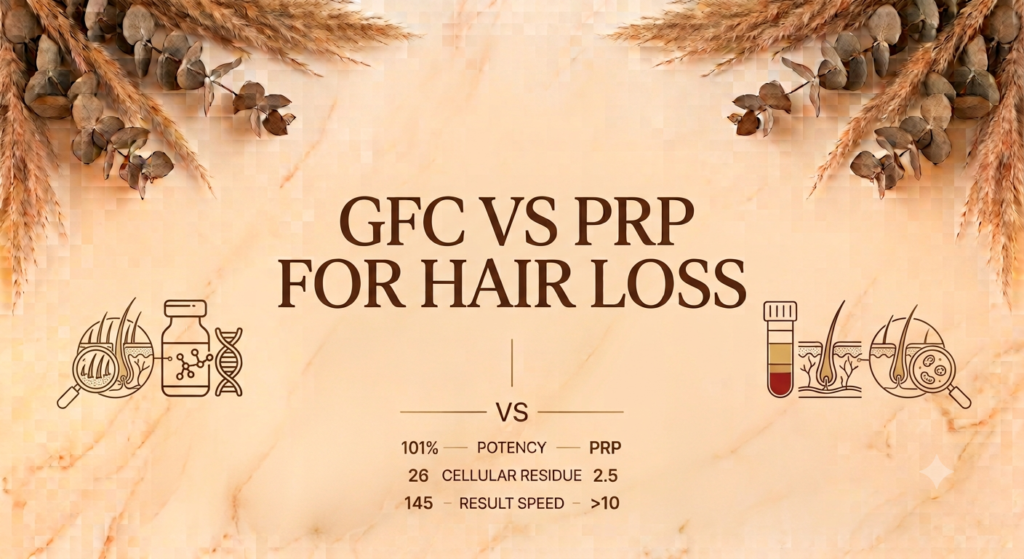
GFC vs PRP for Hair Loss is a common question among people looking for effective options for hair thinning and hair fall. Both treatments use components derived from your own blood and are used to support hair growth, but they are prepared differently and may be considered for different situations.
So, which treatment is better for hair loss: GFC or PRP?
The answer depends on the type and stage of hair loss, the condition of the hair follicles, previous treatments, and your dermatologist's assessment. Neither treatment can be considered universally better for every patient.
GFC vs PRP for Hair Loss: Which Treatment Is Better?
Rather than asking which treatment is "better" overall, it is more useful to ask which treatment is more suitable for a particular type of hair loss and treatment goal.
| GFC | PRP |
|---|---|
| Focuses on delivering concentrated growth factors | Uses platelet-rich plasma containing platelets and growth factors |
| A newer approach in hair restoration | Has been studied for hair loss for a longer period |
| May be considered when growth-factor-based treatment is being explored | May be considered for certain types of pattern hair loss |
| Research is promising but still developing | Has a larger body of published research |
| Protocols can vary depending on the preparation system | Preparation and treatment protocols also vary between clinics |
Recent research has reported promising results with growth-factor-based injections, including GFC, for androgenetic alopecia. However, studies use different preparation methods and protocols, so the results should not be interpreted as proof that GFC is automatically better than PRP.
When May GFC Be Considered for Hair Loss?
GFC may be considered when the goal is to use a concentrated growth-factor preparation to support existing hair follicles.
It may be discussed as an option for people experiencing early or moderate hair thinning where follicles are still present and capable of producing hair.
A dermatologist may consider GFC when:
- Hair density has started decreasing
- Hair strands are becoming progressively thinner
- There is early-stage pattern hair loss
- The patient wants a blood-derived regenerative treatment
- Existing follicles are still viable
- A growth-factor-focused approach is considered appropriate
GFC should not be viewed as a treatment that can recreate follicles that are completely lost. The condition of the follicles is an important factor when discussing expected results.
Emerging clinical research has reported improvements in hair-count measurements following concentrated growth-factor treatment, although more standardized research is still needed.
When May PRP Be Considered for Hair Loss?
PRP may be considered for certain patients with pattern hair loss and other forms of non-scarring hair thinning.
PRP has been investigated more extensively than GFC and is commonly used as a regenerative treatment for selected patients.
It may be discussed when:
- There is gradual pattern hair thinning
- Hair follicles are still present
- The goal is to support hair density
- The dermatologist believes PRP is appropriate for the diagnosis
- The patient is looking for a non-surgical treatment option
The American Academy of Dermatology's information on PRP for hair loss notes that dermatologists may use PRP for certain types of hair loss.
However, PRP is not a universal treatment for every form of hair shedding.
GFC vs PRP for Hair Loss: What If Hair Loss Is Recent?
If hair loss has started suddenly, the first question should not necessarily be whether you need GFC or PRP.
Sudden hair shedding can occur after illness, significant stress, hormonal changes, nutritional problems, certain medications, or other triggers.
In such cases, identifying and addressing the underlying cause may be more important than immediately starting an injection-based treatment.
This is why a dermatologist in Lucknow may first evaluate the pattern and history of your hair loss before recommending a procedure.
If the underlying condition is temporary, treating the trigger may be an important part of management.
GFC vs PRP for Hair Loss: What If You Have Pattern Hair Loss?
Pattern hair loss, also known as androgenetic alopecia, develops gradually and can affect both men and women.
Common signs include:
- Gradual thinning at the crown
- Receding hairline
- Wider hair part
- Reduced overall density
- Thinner individual hair strands
For patients with pattern hair loss, PRP or GFC may be considered as part of an overall treatment plan.
However, regenerative treatments do not necessarily replace other evidence-based treatments.
For example, minoxidil is an established treatment for certain types of pattern hair loss. Research has also examined PRP combined with topical minoxidil. A 2024 systematic review found improvements in some hair-density outcomes when PRP was combined with topical minoxidil, although the certainty of evidence was limited.
This means the question may not always be GFC vs PRP. In some patients, the more relevant question is how either treatment fits into a broader hair-loss management plan.
GFC vs PRP for Hair Loss: What If Hair Follicles Are Very Weak?
The stage of hair loss matters.
If follicles are still producing very fine, miniaturized hairs, there may be an opportunity to support them through appropriate treatment.
But if an area has been completely bald for a long period, expectations from injectable regenerative treatments may be different.
Neither GFC nor PRP should be presented as a guaranteed way to restore hair where functioning follicles are no longer present.
A dermatologist can examine the scalp and determine whether the follicles appear suitable for the proposed treatment.
GFC vs PRP for Hair Loss: Which One Has More Research?
PRP currently has a larger body of published research in hair-loss treatment.
PRP has been investigated across numerous clinical studies and systematic reviews, particularly for androgenetic alopecia.
GFC is a newer and developing area of research. Recent studies are encouraging, but there is still a need for larger, standardized clinical trials.
A recent review of PRP research discusses its potential role in androgenetic alopecia while also highlighting differences between preparation and treatment protocols.
Meanwhile, newer research into growth-factor injections has reported potential improvements in hair density and thickness but also highlighted substantial variation between studies.
So, when comparing the evidence, PRP has a longer research history, while GFC represents a newer approach with emerging evidence.
GFC vs PRP for Hair Loss: What About Maintenance?
Hair loss, particularly pattern hair loss, is often a progressive condition.
That means improvement from a procedure does not necessarily mean the underlying tendency toward hair loss has disappeared.
Depending on your diagnosis and treatment plan, maintenance sessions or other forms of ongoing treatment may be discussed.
The American Academy of Dermatology's guidance on hair-loss treatment explains that different causes of hair loss require different management approaches.
This is why your dermatologist should discuss not just the initial number of sessions, but also what happens after the initial treatment course.
GFC vs PRP for Hair Loss: Which Treatment Should You Choose?
If you are searching for GFC treatment in Lucknow, PRP treatment in Lucknow, or hair loss treatment in Lucknow, avoid choosing a procedure solely because it is advertised as newer or more advanced.
Instead, discuss:
- What type of hair loss do I have?
- Are my follicles still active?
- Why are you recommending GFC or PRP?
- How many sessions may be needed?
- When should I expect to evaluate the results?
- Will I need maintenance treatment?
- Should medication be part of my treatment plan?
- What alternatives are available?
A proper diagnosis can make the choice much clearer.
GFC vs PRP for Hair Loss: The Bottom Line
GFC and PRP can both be considered for selected patients with hair thinning, but neither is universally better for everyone.
GFC may be considered when a dermatologist believes a growth-factor-focused approach is suitable. PRP may be considered for selected patients, particularly those with certain forms of pattern hair loss, and it has a longer history of clinical research.
If you are looking for the best dermatologist in Lucknow or a skin doctor in Lucknow for hair concerns, the most important step is to determine the cause and stage of your hair loss before selecting a treatment.
The right question is not simply "GFC or PRP?"
It is:
"Which treatment is appropriate for my hair loss, and why?"